


Most ankle pain comes from misses (not jumping)
Buying a weighted jump rope? Here’s the question most people don’t ask until it’s too late:
What happens when I miss?
Because weighted jump rope ankle pain usually isn’t from “jumping rope.” It’s from the rope smoking your ankles when you trip—over and over—until you start dreading the workout. And if you’ve ever used a traditional weighted rope, you already know: one bad miss can end the session.
This post is direct on purpose. Here’s what causes ankle pain, how to fix it fast, and how to keep training hard without sacrificing your ankles.
First: what “ankle pain” are we talking about?
There are two common problems:
- Impact pain (rope strikes)
You miss a rep and the rope hits your ankles/shins. - Overuse pain (tendons/joints)
Too much volume too soon, usually paired with stiff jumps and bad surfaces.
Most people have a mix of both. Let’s solve both.
Cause #1: You’re going too fast (and missing constantly)
Weighted ropes punish speed. If you’re tripping a lot:
- Slow your cadence down
- Keep jumps low (quiet feet)
- Stay on singles only
Fix (simple): Use intervals.
Start with 15–25 seconds on, then rest. Earn longer sets.
Start with 15–25 seconds on, then rest. Earn longer sets.
Want the full beginner plan? Use this guide:
https://getflatrope.com/how-to-use-a-weighted-jump-rope/
https://getflatrope.com/how-to-use-a-weighted-jump-rope/
Cause #2: Your hands are drifting wide (classic mistake)
When your hands flare out, the rope path gets sloppy and you clip your feet.
Fix (instant):
- Hands low, slightly forward
- Elbows close
- Rotate from wrists (not big arm circles)
If your shoulders are burning, that’s usually a form issue—not “weakness.”
Cause #3: You’re jumping too high (and landing heavy)
Big jumps = big impact. Over time, that can irritate ankles/Achilles.
Fix:
- Think “bounce,” not “leap”
- Soft knees
- Land under your hips, not in front
Cause #4: Your surface is wrecking you
Concrete + heavy rope + high volume = regret.
Fix:
- Rubber gym flooring is best
- A flat mat works
- Avoid slick floors (more misses)
- Avoid uneven outdoor surfaces when you’re learning
Cause #5: Rope design (the one nobody wants to admit)
Here’s the truth: some weighted ropes are brutal when you miss. If the rope is round, dense, and moving fast, it can hit like a whip.
So if you’re buying a weighted jump rope, ask:
- Is it designed to reduce ankle strikes on misses?
- Or does it punish every mistake?
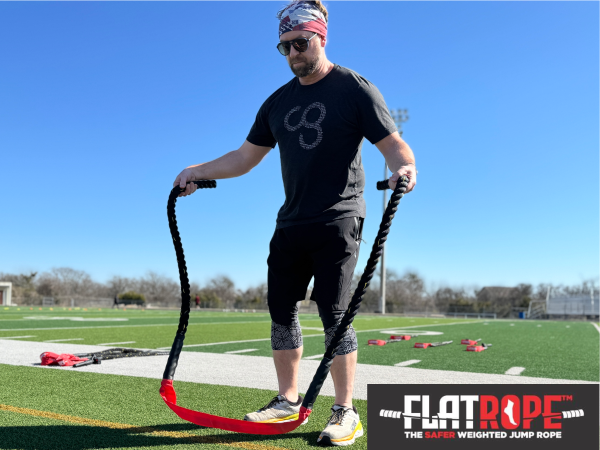
FLATROPE was created around one mission: #SAVETHEANKLES. The flat mesh center is designed to reduce ankle strikes so you can train hard, miss sometimes (because you’re human), and keep going.
Mid-post CTA
Want to train hard without dreading every miss?
- 5 lb full-body conditioning tool
- Flat mesh center designed to reduce ankle strikes
- Built for athletes who actually push pace
Shop FLATROPE >
And it’s backed by our lifetime workmanship warranty
The “ankle-safe” progression (do this for 2 weeks)
If you’re dealing with rope strikes or ankle irritation, run this progression 3x/week:
Session (10 minutes)
- 10 rounds:
- 20 seconds weighted rope singles (easy pace)
- 40 seconds rest
Rules
- If you miss more than 2 times in a set, slow down next round.
- Stop before form breaks.
- Keep it boring. Boring builds consistency.
After 2 weeks, progress by:
- adding 5 seconds to the work interval, or
- cutting 5–10 seconds off rest
When to stop (don’t be stubborn)
Stop and reassess if you have:
- sharp pain (not just soreness)
- swelling
- pain that changes your gait
- pain that worsens session to session
Training fearlessly doesn’t mean training stupid.
FLATROPE sizing
- 110″ length: athletes under 6’2″
- 120″ length: athletes over 6’2″
If you’re between sizes and tripping a lot, go longer while you learn.
FAQ: weighted jump rope ankle pain
Usually because you’re missing reps and the rope is striking your ankles/shins, plus you may be doing too much volume too soon.
Slow down, keep hands low and close, jump lower, and use intervals until you can stay consistent.
It’s intense, but it’s usable if you treat it like strength + conditioning and start with short sets.
Rubber gym flooring or a flat mat. Avoid concrete and slick floors when you’re learning.
Yes. If a rope punishes misses, you’ll dread training. A design that helps reduce ankle strikes can make consistency way easier.
- 110″ length for up to 6′ 2″
- 120″ length for over 6′ 2″


7 Comments
Comments are closed.